How to Make Money Baking From Home
Cottage food laws let you sell many baked goods from your own kitchen. What you can sell, how to label and price it, and why holiday orders are the place to start.
Time to get good: 2–6 months to make 3–5 items the same way every time · Start-up cost: Low: your own kitchen, packaging, labels and any state registration or training · Demand: Seasonal, highest from mid-November through December · Typical pay: You set your prices; for comparison, employed bakers earn $28,120–$49,020 a year (BLS, May 2025)
Yes, you can sell baked goods from your home kitchen in every US state, but each state writes its own rules. Harvard's Food Law and Policy Clinic notes that all fifty states now allow at least some "cottage food" sales, usually low-risk foods like breads, cookies, candy, jams and granola. What changes from state to state is which items count, where you can sell, how much you can earn before you need a commercial kitchen, and what goes on the label.
If holiday orders are your goal, start now. Cookie boxes, pies and bread for family dinners get ordered weeks ahead, and the first orders usually come from people who already know your baking.
Is it ready to sell?
Answer these honestly before you take money for it:
- Can you make the same item ten times in a row and have it come out the same size, texture and look?
- Do you know your exact recipe weights, so you can list every ingredient and allergen?
- Will it survive a car ride and two days on a counter without refrigeration?
- Have people outside your family paid for it, or asked to?
The third question matters most for the law. Cottage food rules are built around foods that are safe at room temperature. Texas, for example, treats items that need time and temperature control for safety (it calls them TCS foods) differently: you can sell them, but you have to register with the state first and print extra safe-handling text on the label. Cream-filled or cream-cheese-frosted cakes and cheesecakes need refrigeration, so check how your state treats them before you put them on a holiday menu.
Ways to use it
Sell holiday boxes and pre-orders
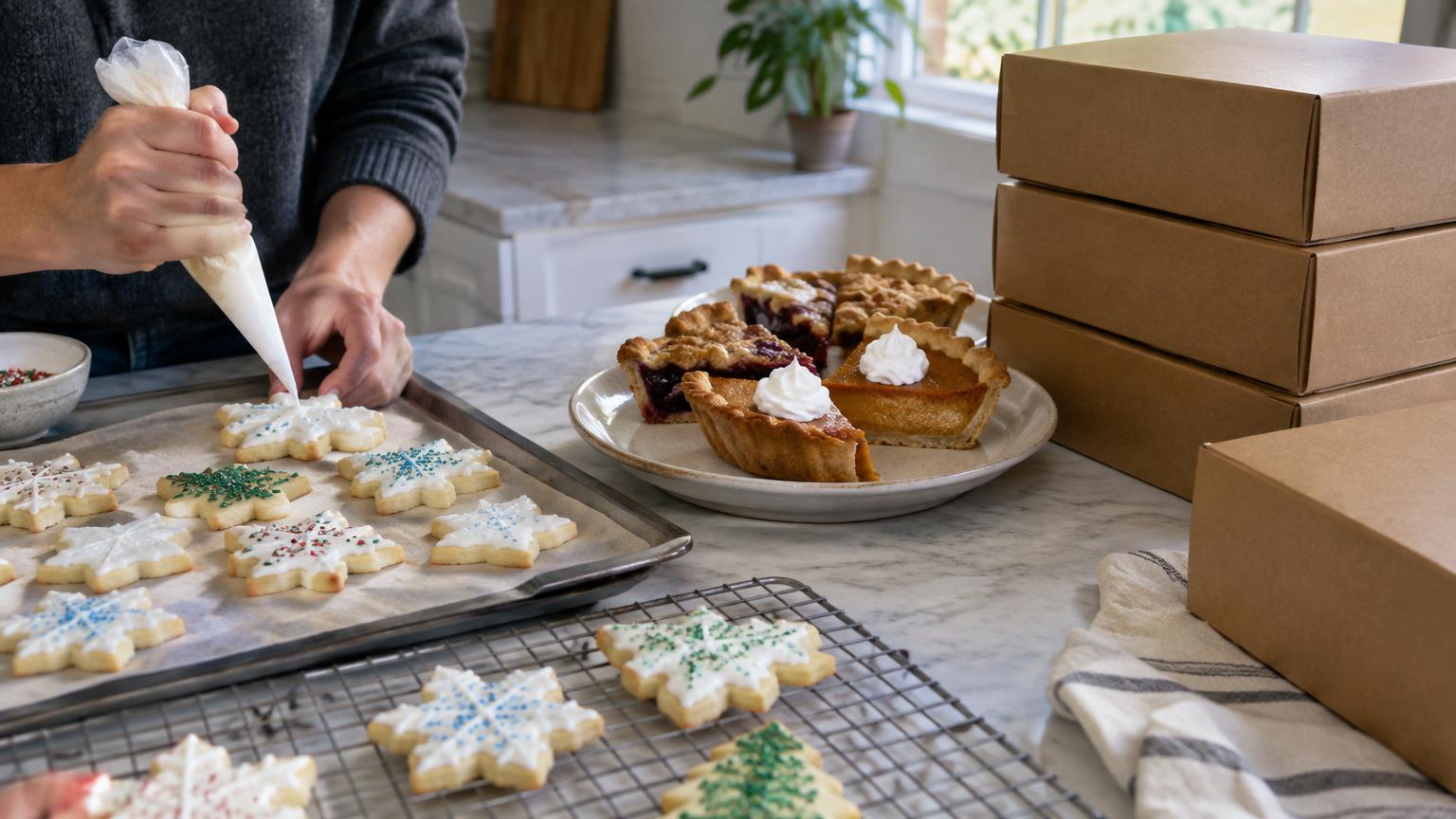
This is the easiest place to start. Pick three or four items that travel well (decorated sugar cookies, shortbread, fruit pies, cinnamon rolls, loaf breads), set an order deadline and a pickup day, and stop taking orders when you hit what your oven can handle. Pre-orders mean you buy ingredients for food that is already sold.
Sell at a farmers market or holiday fair
Markets put your baking in front of strangers. Both Texas and Florida allow direct, in-person sales, and Texas names farmers markets and farm stands outright. Some markets run winter or holiday editions. Ask the market manager what they require from cottage food vendors, since many have their own rules and fees on top of the state's.
Take custom orders
Birthday cakes, wedding-shower cookies and decorated sets for teachers pay better per hour once you are fast, but they also bring the most back-and-forth. Charge a deposit and write down the order details.
Teach it
A cookie-decorating evening for a scout troop or a bread class at a community center uses the same skill without the packaging and labels. Ask the venue what it requires from you, especially if you serve what you bake.
Keep it a joy
Baking for your street, your church sale or your kids' teachers is a fine way to use the talent. Not every good baker wants to run a small food business in December.
Where people find work
The rules shape where you can sell, so check your state first. Two examples, from each state's own pages:
- Texas: No permit is required, and local health departments may not require one. You must complete an accredited food handler course. Annual gross income is capped at $150,000. You can sell in person, at farmers markets and farm stands, and online if you, an employee or a household member delivers the food yourself. Labels need your name and address (or a state-issued ID number if you register), the product name, major allergens, and the statement "THIS PRODUCT WAS PRODUCED IN A PRIVATE RESIDENCE THAT IS NOT SUBJECT TO GOVERNMENTAL LICENSING OR INSPECTION." Updated rules from Senate Bill 541 took effect September 1, 2025.
- Florida: No food permit is needed for cottage foods, and gross sales are capped at $250,000 a year. Florida allows sales online, by mail order and in person, and wholesale is not allowed. The state's list of approved foods includes loaf breads, cakes, cookies, candies, fruit pies, granola and honey. Florida law requires every product to be prepackaged with a label showing the business name and address, product name, ingredients in order of weight, net weight, allergens, and, in at least 10-point type: "Made in a cottage food operation that is not subject to Florida's food safety regulations."
In practice, home bakers find their buyers through neighbors, local social media groups, school and church networks, markets and word of mouth from the first boxes. If you want your packaging to stand out, hand-lettered tags are a skill of their own; our page on selling calligraphy covers that side.
Your first 30 days
- Days 1–3: Read your state's cottage food page (usually the health or agriculture department). Note the allowed foods, any registration or training, the sales cap and the label wording.
- Days 4–10: Choose three items that keep at room temperature. Bake each one three times and weigh everything.
- Days 8–12: Price them. Add up ingredient cost per batch, packaging and labels, then add your time at an hourly rate you would accept. If a dozen cookies takes 90 minutes of active work, your time is part of the price. A cost sheet in a spreadsheet makes this quicker, and simple Excel skills go a long way here.
- Days 12–15: Print labels that meet your state's rules. Take clear photos in daylight.
- Days 15–20: Post a holiday menu with an order deadline, a pickup or delivery day and a cap on the number of boxes.
- Days 20–30: Bake, deliver, and keep notes: what sold out, what took too long, what people asked for that you did not offer.
The honest downsides
- The hours are long and bunched up. Holiday demand lands in the same three or four weeks, and home ovens are small.
- Margins are thinner than they look. Butter, eggs, boxes, labels and market booth fees all come out of the price. Bakers who forget to count their time often find they earned very little per hour.
- The rules limit what you can sell. Many profitable items, such as cheesecakes and cream pies, may need refrigeration and fall outside cottage food rules or need extra steps.
- Taxes still apply. Florida's law says it does not exempt cottage food operators from state or federal tax rules, and some states tax certain food sales. If you clear $400 or more in net self-employment earnings in a year, the IRS requires you to file Schedule SE and pay self-employment tax of 15.3%.
- Pay figures are for employees. The BLS bakers data excludes self-employed bakers, so it shows what bakery jobs pay, not what a home business earns. Your income depends on your prices and how many boxes you can make.
Sources
- Cottage Foods and Home Kitchens, Center for Health Law and Policy Innovation, Harvard Law School
- Texas Cottage Food Production, Texas Department of State Health Services
- Cottage Foods, Florida Department of Agriculture and Consumer Services
- Florida Statutes section 500.80, Cottage food operations
- Bakers, Occupational Outlook Handbook, US Bureau of Labor Statistics
- Self-employment tax, Internal Revenue Service
